
The 2020 Association of American Universities survey found that 17% of students identified as LGBQ, while 1.7% identified as transgender, nonbinary, or questioning (Cantor et al., 2020, p. 311), yet little research has been done on their experiences in campus residential housing. LGBTQ+ students face a myriad of barriers on college and university campuses, including within residential housing (Mollet et al., 2021), where they may experience bullying and harassment, which then has a negative impact on their sense of belonging within the campus community (O’Neill et al., 2022).
Residential Learning Communities
Residential learning communities (RLCs) are intentional programs within campus residence halls that offer a wide range of planned learning and social opportunities (Hurtado et al., 2020; Inkelas & Soldner, 2011) in communities that share several characteristics: Students live together on campus in a defined space, share an academic or cocurricular experience, and participate in structured activities in the residential space (Brower & Inkelas, 2010).
The academic and social benefits of RLCs are numerous and well documented, spanning at least 30 years of research. Pike (1999) found that “students in residential learning communities had significantly higher levels of involvement, interaction, integration, and gains in learning and intellectual development than did students in traditional residence halls” (p. 269). Students in RLCs also have higher retention rates (Hotchkiss et al., 2006), report higher satisfaction with college (Baker & Pomerantz, 2000), and have favorable educational and social outcomes (Inkelas et al., 2018).
In fact, the Association of American Colleges and Universities (AAC&U) lists RLCs as one of the 10 high-impact practices that promote academic, extracurricular, and interdisciplinary engagement for undergraduate students (Kuh, 2008). Students who participate in RLCs report a greater capacity for critical thinking (Inkelas et al., 2006), along with higher levels of interaction with faculty (Garrett & Zabriskie, 2004). Socially, these students benefit from increased student-faculty interactions and a greater sense of belonging, which contributes to their feelings of inclusivity and affiliation with the university (Dodd, 2002). Students in RLCs often experience a more diverse landscape than do their non-RLC peers, as well as a higher engagement with people from different backgrounds (Sriram et al., 2020).
Furthermore, students in minority groups experience positive outcomes from participation in a residential learning community. For example, those in an RLC designed specifically for LGBTQ+ students reported a strong sense of belonging, connection, and engagement (Atteberry-Ash et al., 2023); international students who lived in RLCs reported higher levels of interactions with faculty than did their non-RLC peers (Eidum et al., 2020); and first-generation students had higher levels of involvement with faculty, peers, and campus organizations, along with a greater sense of belonging (Markle & Stelzriede, 2020).
Identity Formation within Residential Learning Communities
The period of young adulthood during the college years is a timeframe in which students undergo a long process of meaningful and multifaceted identity exploration (Arnett & Tanner, 2006). This process can be enhanced by participation in an RLC (see Jaiswal et al., 2022; Jordyn & Byrd, 2003), though few studies have examined this positive association. In a mixed-methods study, Jaiswal and colleagues (2022) reported that students who attended specific events within the learning community and interacted with faculty and staff in the community were able to develop their leadership capabilities and sense of belonging, but few other studies have focused specifically on how this identity development is impacted by participation in an RLC. The purpose of the present study was to understand how students felt about their identities within the RLC and to explore this issue through the use of memes, or what Richard Dawkins refers to as units “of cultural transmission” (1976, p. 176).
LGBTQ+ Identity Formation
Studies and theories of identity development have largely explored the topic from a cisgender heterosexual perspective that neglects multidimensional conceptualizations of sexual orientation and gender identity (Bishop et al., 2020). The term sexual orientation most often refers to attraction, behavior, romantic feelings, and self-identification (Hall, 2019). With these constructs in mind, sexual orientation identity development “refers to changes, processes, and experiences over time that can involve awareness, exploration, appraisal, commitment, integration, and communication concerning a person’s identity as a sexual being, which is based on their patterns of sexual attractions and behaviors” (Hall et al., 2021, para. 2). The term gender identity refers to “a person’s innermost concept of self as masculine, feminine, a blend of both, another gender(s), or none” (The Trevor Project, 2024, para. 1).
The process of identity formation for transgender and gender-diverse individuals is both a personal one (exploring internal feelings of gender, including euphoria and dysphoria; gathering information; and interacting with family and friends) and a social one (updating pronouns and/or names and experimenting with gender expression and gender-affirming clothing and products) (Pullen Sansfaçon et al., 2020). These personal and social processes can often occur simultaneously and throughout different stages over a lifetime (Pullen Sansfaçon et al., 2020).
The formation of gender identity may also involve understanding different concepts and models of gender, experimenting with gender, having difficult experiences related to gender identity, and having conversations about gender identity (Nordmarken, 2023). However, we caution that these models, especially linear ones, are not representative of the experiences of all gender-diverse individuals or others in a sexual minority, especially those living in politically oppressive states or contexts. This study seeks to fill this gap in the literature by exploring students’ LGTBQ+ identity development in a university within a state that has adopted increasingly harmful policies directed at LGBTQ+ individuals and implemented bans on university policies related to diversity, equity, and inclusion. The RLC program in this study was directly impacted by these shifts at the state level.
The Use of Memes in Research
The term meme was introduced by Richard Dawkins in his 1976 book The Selfish Gene, and he used memes to describe how ideas and aspects of culture such as fashion, language, or sports references spread and are replicated, similar to how genes replicate, i.e., “it can give rise to a form of evolution” (p. 166). While there is no singular definition of what a meme is (Al Rawi, 2021; Gbadegesin, 2019), some researchers believe it is characterized by humor (Gbadegesin, 2019), while others contend that memes are an important part of culture, often influencing ideologies shared via the internet and social media (Davison, 2012; Gbadegesin, 2019; Shifman, 2013). For this research, we define memes as images with text that are created to communicate humor, politics, a particular cultural perspective, or a current social issue (Majmundar et al., 2023).
For marginalized groups, participating in the creation of digital technologies, such as memes, can strengthen a person’s sense of community and individual identity. Meme groups on Facebook, for example, provide an opportunity for members to create shared identities, which can then lead to a sense of group membership, making people feel part of an audience and a community that identifies with the content and values within the meme (Zappavigna et al., 2022). Memes can be an important addition to the qualitative research landscape and an important tool for collecting the feelings, ideas, and experiences of research subjects in response to key research questions, as well as supporting relationship building and allowing people to better process and reflect on their current lived experiences (Iloh, 2021). While several studies examine the language and ideology of memes (Davison, 2012; Gbadegesin, 2019; Knobel & Lankshear, 2007; Shifman, 2013), there are few that specifically explore the role of meme creation in the research process. In terms of memes and identity exploration, the internet is an important community gathering space and source of information for transgender individuals, and memes play a critical role in catalyzing moments of identity realization (Nicolazzo et al., 2022). The limited research on memes and the important role that memes can play in identity formation highlight the importance of this project in advancing our understanding of the impacts that RLCs have on young LGBTQ+ individuals.
METHODS
This study took place within an LGBTQ+ residential learning community at a large urban university in the southern United States. The RLC was initiated in 2021 as a collaboration between the LGBTQ+ program and campus housing. This project gathered information from the program’s first two cohorts of residents and was part of a larger participatory action research study conducted with RLC residents that centered the students as co-researchers who were instructed in research methods and different types of data collection, including art-based methods, that are often present in participatory action research projects (Domínguez & Cammarota, 2022; Nunn, 2022). Students then identified outcomes that mattered most to them (e.g., for this paper, identity formation) and selected approaches to collect data aligned to those outcomes (e.g., memes for identity formation). After approval from the study site’s Institutional Review Board, the study took place during the 2021-22 and 2022-23 school years in a state with several anti-LGBTQ+ and anti-diversity, equity, and inclusion policies, which had begun to flow into the university setting via programming, class offerings, and language changes on syllabi and the website.
Participants
All students in the LGBTQ+ learning community were invited to join the study. They received information about the larger participatory action research study at the first RLC community gatherings of each academic year. All students, in both cohorts (year one and two), joined the study. In year one, 13 students were in the RLC at the beginning of the academic year, while 9 remained at the end of the year. In year two, 10 students were in the RLC, and all remained at the end of the academic year.
Data Collection
Given that the creation of memes can be used to build community around a common identity or experience (Iloh, 2021), the memes for this project were created during an initial meeting of the LGBTQ+ learning community as a community-building activity (pre-memes) and then again in the spring as a close-out of the academic year and the students’ time in the RLC (post-memes). The process of creating memes provided a way for students to connect with one another by sharing aspects of their lives through humor. This approach facilitated the development of a sense of community, as students recognized shared experiences and challenges. Additionally, the use of humor helped to lower their defenses, fostering a more open and supportive environment for engagement and connection. Using Iloh’s (2021) suggestion for incorporating memes in qualitative data collection, students were asked to provide a meme as a response to the following prompt: Make a meme of how you felt about you, your identity, or your overall state of being before (pre) and after (post) you started participation in the LGBTQ+ residential learning community. Before answering the question, students were given a brief presentation on memes and were provided a link to a meme generator (Imgflip, 2025a); before meme creation took place, they were shown three examples of memes that the first author created as a response to the question (see Example 1).
Two memes were removed from the study because they were unrelated to the prompt; for example, one was about missing a parent’s cooking. In total, for the memes collected at the beginning of the academic year, 28 were included in the pre-analysis, while 13 were included in the post-data collection. For pre-memes, all students in each year created a meme, with one person creating two memes (in year one); for post-memes, 7 of 9 students created memes in year one, while 9 of 10 students created memes in year two.
Data Analysis
We used a thematic analysis approach to find patterns and commonalities among the different memes (Braun & Clarke, 2006). First the researchers reviewed all the memes independently to get a better understanding of the data; all authors took notes during this process and came together with ideas about the direction we would take in analyzing the memes (Creswell, 2013). Next, we each independently engaged in first-round coding of the memes, identifying key phrases that represented the data. After this step, we came together to see how each of the authors independently coded the memes; if there was alignment, we kept the codes, but if there were differing perspectives, we discussed the memes and the codes we gave them and then came to consensus regarding how to make meaning of the meme. From this process, we organized the codes into patterns or themes using Canva.
It is important to note that the first author left the university, and the program was disbanded due to state-level policies. Because of this, no participants were involved in the analysis, which is not typical for a participatory action research project. Under different circumstances in a project where we were interpreting images, participant involvement with analysis (including coding and finding themes) would be necessary. Given this, the coding team used bracketing via comments in Microsoft Word throughout both the coding process and the writing process to note any feelings or thoughts that came up for us as researchers (Tufford & Newman, 2012). We would also discuss the comments we bracketed, participating in collective reflexivity, which felt especially important to us as a team of LGBTQ+ researchers, given that we were or had been impacted by some of the same subjects that were illustrated in the memes (Sandwick et al., 2018).
FINDINGS
For the pre-memes, two primary themes were built: identity realizations and community. For the first theme, four sub-themes emerged: euphoria, neutral identity realizations, identity realizations related to internal stressors, and identity realizations related to external stressors. For the second theme, community, two sub-themes emerged: excitement about community and fear related to community. For the post-memes, the two primary themes that emerged were the same as those for the pre-memes: identity realizations and community. However, a third theme also emerged: in-group messages. For the post-memes related to identity realizations, the sub-themes were the same, except that no themes emerged related to external stressors. Lastly, for community in the post-themes, there were no sub-themes, as all the memes about community were positive.
Pre-Memes
In the pre-memes, students reflected on identity realizations and community.
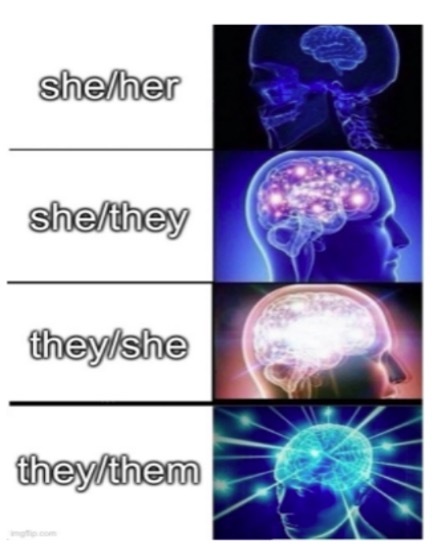
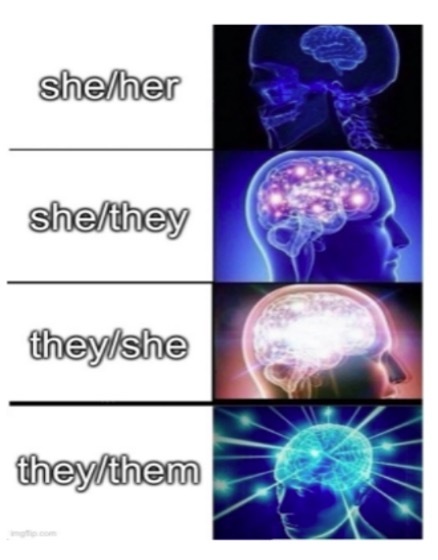
Identity realizations. This theme represented memes that expressed excitement or happiness about gender, gender expression, sexual orientation, names, and pronouns. Overall, there is no single agreed-upon definition of euphoria related to gender identity (Beischel et al., 2022) or sexuality, though it is commonly understood as feelings of joy related to satisfaction, happiness, comfort, and sureness regarding one’s body, gender identity, gender expression, and in our case sexual orientation (Austin et al., 2022; Beischel et al., 2022; Bradford et al., 2019; Cosgrove et al., 2021; Jacobsen & Devor, 2022). Specifically, students who were exploring their sexuality shared through memes the euphoria and excitement they experienced related to kissing girls, while at the same time expressing a rejection of their prior identity related to kissing boys. Another example was transgender students’ feelings of euphoria as they explored their pronouns and eventually settled on the ones that best represented them (Figure 1).
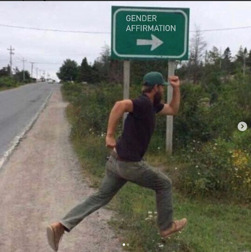
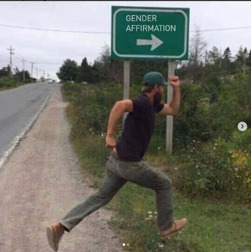
Students created memes related to their awareness of exploring and accepting their gender identity and sexual orientation. Several students created images with the popular Uno card meme (Imgflip, 2025b) and said they would rather draw 25 Uno cards than identify with their assigned gender at birth or be cishet (cisgender or heterosexual). Another student created a meme that expressed the process of discovering their sexuality (Figure 2), illustrating this with a popular meme of an older person discovering the internet for the first time and being in awe of the discovery.

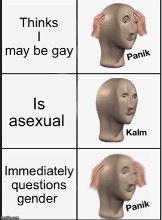
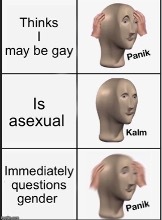
Students also created memes related to the internal stress they felt as they explored their identities. They crafted images that grappled with both the joys of realizing they were LGBTQ+ and the fear of coming out; some had even begun to doubt the new pronouns or labels they were using. Students also illustrated the complexity of identity exploration as it relates to sexual orientation and gender identity and how the exploration of sexual orientation relates to and often overlaps with gender identity (Figure 3).
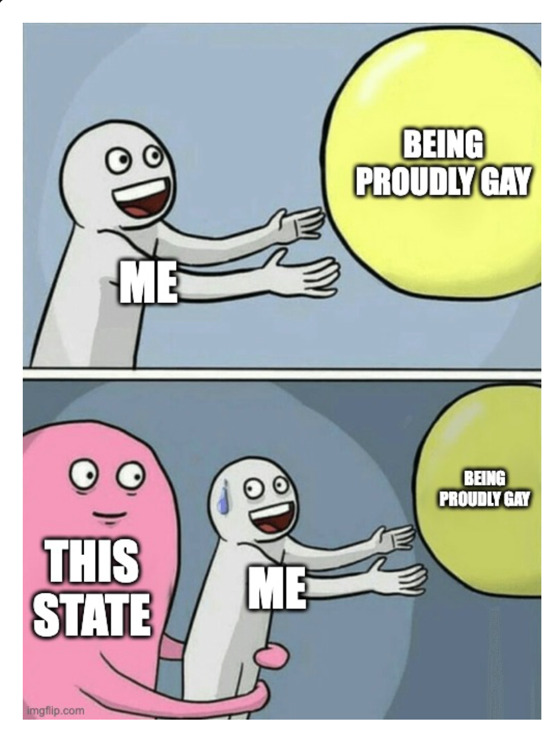
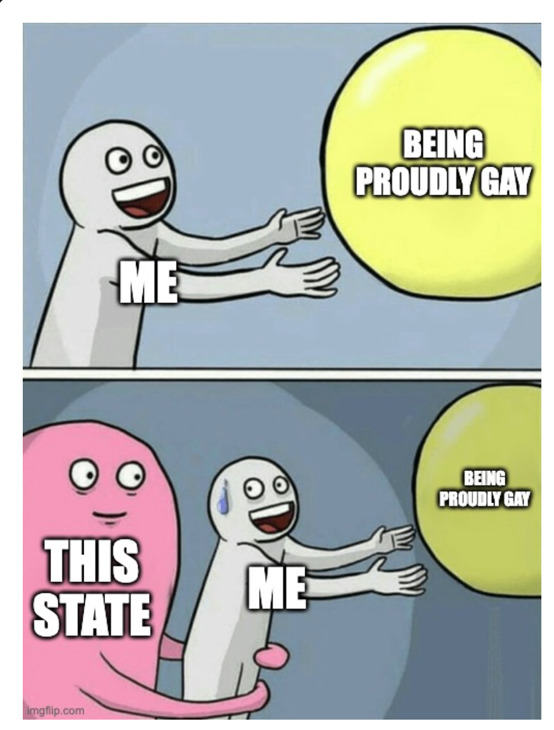
Participants revealed the tensions they experienced as they explored their identities and faced external pressures. Some specifically named being afraid of their parents’ opinions and of feeling tension between who they are and who their parents think they are. One participant shared an image (Figure 4) that expressed the joy they felt being gay but also the negative impacts of the state’s political environment and how anti-LGBTQ+ legislation and policies hold them back.
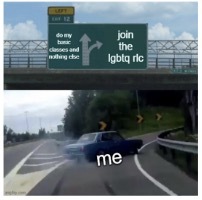
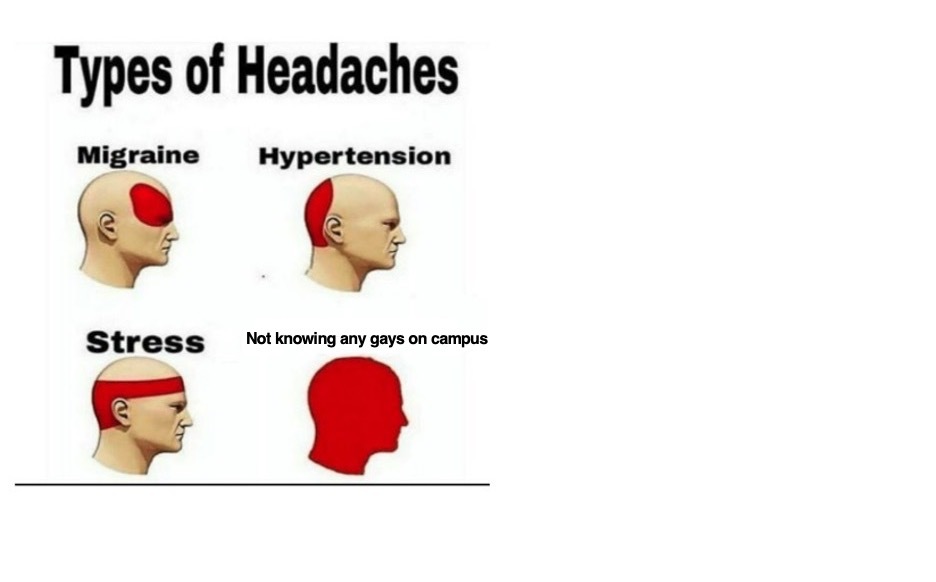
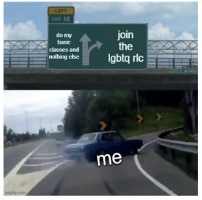
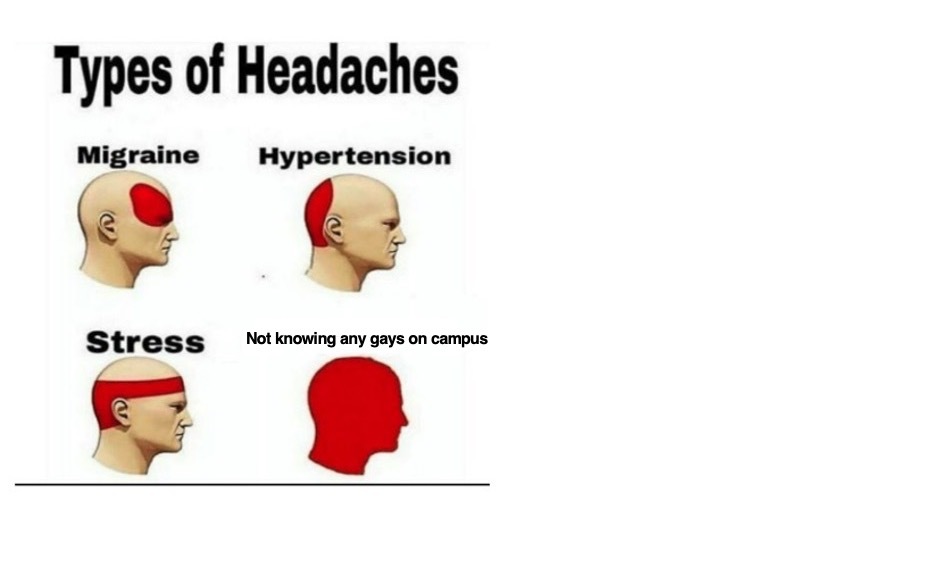
Community. Participants expressed happiness and anticipation about simply joining the residential community. Figure 5 illustrates a student enthusiastically choosing to join the community instead of being part of the basic status quo as a first-year student. Fear related to lacking a sense of belonging illustrated how isolated the student had felt in the initial weeks of their first year, and lack of connection to LGBTQ+ friends or peers made this worse (Figure 6). The residential community alleviated students’ fear by serving as a built-in community of LGBTQ+ peers.
Post-Memes
Students also reflected on identity realizations and community in the post-memes, and their memes illustrated the kind of in-group messages that reflect being part of a small community.
Identity realizations. The post-memes included reflections on the euphoria related to the appropriate use of pronouns and participants’ awareness that certain aspects of their identity and their experience of joy were related to that. One student in particular mentioned the excitement they felt when someone used the pronoun “they,” though they acknowledged also being okay with “she.”
Participants also indicated more neutral identity realizations. For example, some made memes that represented the experience of being pansexual and navigating their attraction to multiple genders, while others illustrated the complexities of identity exploration in general. In the post-memes, students continued to illustrate the internal stress they were feeling related to who they were. One participant acknowledged that who they saw in the mirror did not match their gender identity, while another recognized the stress of navigating their attraction to multiple genders.
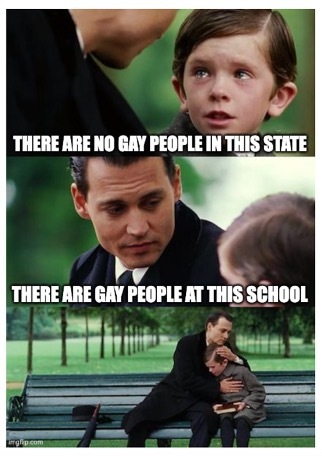
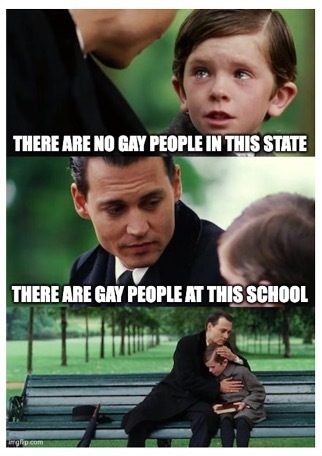
Community. Participants clarified the role that the residential learning community played in building an inclusive community at the university. In the post-memes, they described how the community facilitated friendships and relationships, enhanced LGBTQ+ visibility (for one student, as shown in Figure 7, there may have previously been none), and provided space to be out of the closet.
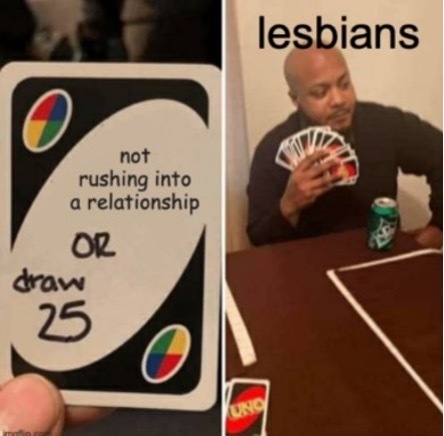
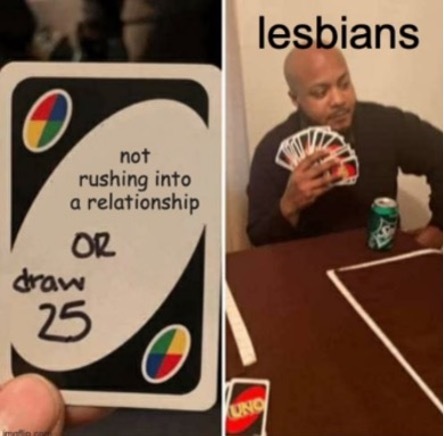
In-group messages. The post-findings for this category were different in two ways. There were no memes that mentioned anything about external stressors, and students created memes that spoke to how, when you are part of a certain identity group, there are in-group messages and inside jokes that refer to stereotypes in a way that is seen as okay because you are part of that group (Zappavigna et al., 2022). Specifically, participants revealed the complexities of dating related to gender identity, gender expression, and sexual orientation, sharing their experiences of bisexuality and dating and attraction. One participant illustrated the lesbian trope of u-hauling (Figure 8), a term used to describe lesbian relationships that are quickly headed to commitment and moving in together (Gieseking, 2020), via a meme about lesbians rushing into relationships.
DISCUSSION AND IMPLICATIONS for practice
Our findings illustrate the positive impact that an LGBTQ+ residential learning community can have on students’ identity formation and on their ability to connect with their peers. Also relevant is that our findings were gathered through the use of memes, which shows that research can be conducted via methods that are engaging to young people and yield important results. This research was conducted in a state where young LGBTQ+ individuals, especially transgender and nonbinary youth, are under attack, both inside and outside of institutions of higher education—so much so that the office that led this work was disbanded due to state-level policy. Figure 4, which shows a figure labeled “this state” pulling a person away from a bubble labeled “being proudly gay,” speaks to the profoundly negative impact that harmful policies can have on young LGBTQ+ individuals, especially in terms of how they feel about themselves. Given the general lack of research regarding the impacts of LGBTQ+ residential learning communities, our findings that participants felt euphoria despite the internal and external stressors of being LGBTQ+, felt connected to LGBTQ+ peers, and created community are especially important for justifying LGBTQ+ residential learning communities.
For both pre- and post-findings, students created memes that illustrated euphoria about their pronouns, gender expression, their chosen names, romantic feelings, and, overall, about how they felt as they realized who they were. Though gender euphoria is a nascent research topic (see Austin et al., 2022; Beischel et al., 2022; Bradford et al., 2019; Cosgrove et al., 2021; Fury, 2019; Jacobsen & Devor, 2022), our findings align well with existing research on the topic, specifically on findings related to a person’s name and the appropriate use of pronouns (Cosgrove et al., 2021; Jacobsen & Devor, 2022), as well as the “joyful feeling of rightness in one’s gender/sex” (Beischel et al., 2022, p. 274).
Participants described the processes they were going through related to their LGBTQ+ identities and how they were figuring out their sexual orientation or gender identity or expression. Some explained that the realization that they were queer or gender diverse was followed by internal and external stress related to the fear they felt about coming out to parents or peers. Others shared memes related to the dysphoria they felt when they looked in the mirror because the reflection did not match how they felt about their gender. These examples fall within the experiences of identity formation, especially the feelings of euphoria and dysphoria and the push and pull of internal experiences that can be accompanied by external pressures (Nordmarken, 2023; Pullen Sansfaçon et al., 2020).
Beyond facilitating participants’ identity exploration and formation, the RLC provided a built-in LGBTQ+ community. In the pre-memes, students illustrated the fear, before being in the RLC, of not knowing other LGBTQ+ peers at the university; but in the post-memes, they were clear that the RLC became not only a space of community and friendship but also one where students trusted each other enough to joke about being LGBTQ+ (Zappavigna et al., 2022). This finding is in line with previous research showing that RLCs facilitate positive social outcomes (Inkelas et al., 2018) along with feelings of inclusivity and the sense of belonging to an informal friendly community (Dodd, 2002).
By offering residential learning communities for LGBTQ+ students, higher education institutions can create an enriched housing experience where students benefit not only from the typical outcomes of RLCs (higher retention, higher satisfaction, academic benefits) but can also explore the expression of their sexual orientation or gender identity in a safe and uplifting environment while creating space where friendships and community can be formed. Again, this work is especially important in states where young LGBTQ+ individuals are under legislative attack. While many states and the federal government have begun attacking higher education (including housing) and programs such as this begin to shutter across the nation, it becomes even more important to support students by maintaining the value of inclusion. This can be achieved by connecting the learning community to a college or academic program that aligns with LGBTQ+ identities. Additionally, the RLC does not need a name explicitly related to LGBTQ+ identity. Universities can focus on residential learning communities that are inclusive not only of LGBTQ+ students but also other students, as gender-inclusive housing does for all eligible students. However, this approach could impact the perception that this is a safe community, so if this feels impossible, staff and faculty can still bolster LGBTQ+ student organizations as they often have more protections in public universities.
LIMITATIONS AND FUTURE RESEARCH
This study uses novel methods to explore the understudied topic of LGBTQ+ residential learning communities, and some limitations exist. Because this was a qualitative arts-based study, the memes were interpreted by a team of researchers. Although steps were taken to ensure consensus on the meaning of the memes, the findings were not described by the students themselves, so they may not be true representations of the students’ illustrations. A larger study, with more students and perhaps multiple campuses using multiple modes of data collection, could address these limitations. Further, a longitudinal study could explore the impacts of an LGBTQ+ residential learning community throughout students’ collegiate experience, which could reveal more clearly the impacts of RLCs on academics and retention. Our hope is that this work can bolster and add to the evidence that housing and student affairs should provide LGBTQ+ residential learning communities for young queer and gender-diverse students.
CONCLUSION
The findings of this study demonstrate that the LGBTQ+ residential learning community was successful in creating space for students to explore their identities, create community, and establish contexts in which they could begin to have insider conversations about who they were—an essential aspect of being part of a group. Spaces like the LGBTQ+ learning community are especially important on campuses in states with discriminatory policies aimed at LGBTQ+ individuals. Lastly, the use of memes in research to explore the impacts of the LGBTQ+ learning community was a method that students found to be fun and engaging, and we suggest that researchers use this approach to collect data.